
Note from Stu: A big thank you goes out to Robert. When I heard that Robert was going to be doing some major heat reduction modifications on his ’98 TJ, I mentioned that I would be glad to share the info with others if he wanted to take the time to snap some photos along the way and do a write-up. Robert shared his dual battery installation with us some time ago. I was able to help with that install while visiting him during a road trip. I wasn’t able to help with this one (one’s real job can certainly get in the way of doing the fun stuff). A lot of good info has been included in his write-up and I hope you find it useful should you decided to adopt some of the changes for your own vehicle. I appreciate Robert taking the time to share this via the web site.
And now Roberts’s write-up…..
My 1998 Jeep TJ (6 cylinder, 3 speed automatic, 4:56 gears and 35″ tires) has always run on the warm side during the summer months at highway speeds. For additional reference, I have swapped in a Novak 2 row aluminum radiator, Hesco high flow t-stat housing and water pump and I have removed the transmission out of the engine cooling circuit completely. Whether in stock configuration with the 30″ tires and 3:73 gears or the current configuration, the temp gauge has operated in the “zero” of the 210 indicator on the dash gauge. This equates to 224* in actual water temperature.
Now folks might be questioning the validity of the dash gauge seeing as its filtered through the computer and normally I would agree with that line of questioning and in fact at one time I did agree with it. In order to assure myself of what was actually happening there was some rather extensive testing performed on my rig using a mechanical gauge as well as an IR temp gun.
The bottom-line is that my rig only sees about a 10* temperature drop across the radiator. There are several theories about why this is happening and myself, I believe the culprits are the AC condenser (which operates at 325*) and its close proximity to the radiator as well as the constrained size of the radiator itself. Since I cannot do anything about the grill size and my wife would have my head if I ripped out the AC, I needed to look at living with the situation. For that I determined that the best I could do was to build in additional cooling reserve and by that I mean an oil cooler.
In doing IR gun testing on my existing radiator mounted oil cooler, I found that if my water temp was 220*, my oil temps would be similar at the output line back to the engine and depending on the situation, even higher by up to 9*. Not good. Research said to me that oil temps at 200* are about optimal so I set that as my goal. I also determined that pulling my off-road camper trailer put additional strain not only on my cooling circuit but also on my transmission circuit so that would need to be addressed as part of this project and lastly, I determined that having my exhaust ceramic coated would also aid in temperature control under the tub as well as inside the exhaust.
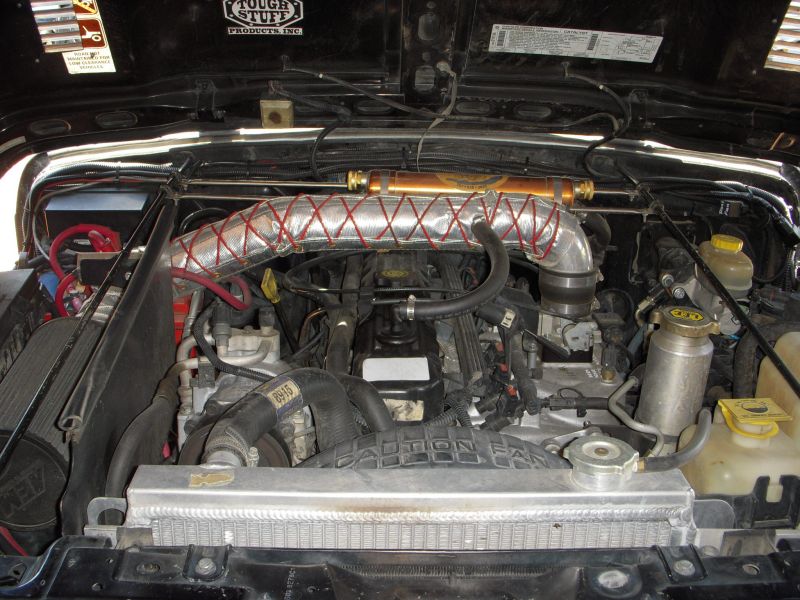
The above photo is my engine compartment in its current configuration with dual batteries, on-board shower heat exchanger and ARB compressor, there is not much room left for anything of size to be mounted under hood. That meant that I needed to look to other areas on the Jeep in which to mount an engine oil cooler. As I had previously ran my engine oil through the Novak radiator only to find that it actually added 9* to my oil temperature, I had to get real creative.
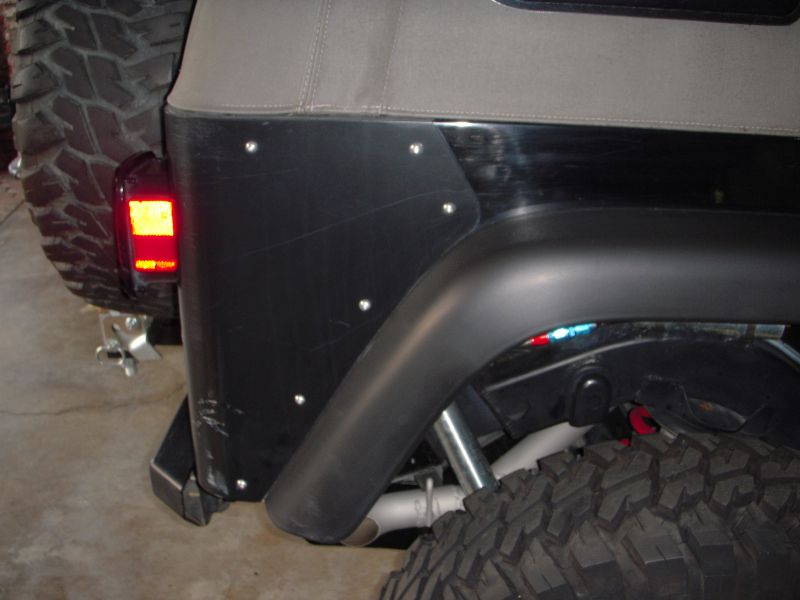
We put the Jeep up on the lift and began to identify areas of dead space that would allow enough room for a cooler and what came out of that was that the rear passenger corner was about the only place left on my rig that had enough available space.
My main concern with that location was the length of the run and whether or not the stock oil pump could effectively handle it.
After some discussion with an inline 6 source over on Pirate 4×4 wherein he clued me into farm equipment applications for the 6 using remote coolers, I was confident that if it were properly engineered, the run would be of no consequence.
Jeep Heat Dissipation Project
Once we identified the space, I needed to work on a cooler. Given the location that was determined, a fan driven unit would have to be found. I have been a fan of Setrab equipment ever since I learned about them while looking at Trophy Trucks for desert racing. After some discussion with a Setrab engineer, I decided on a Setrab Fanpack model FP119M22.
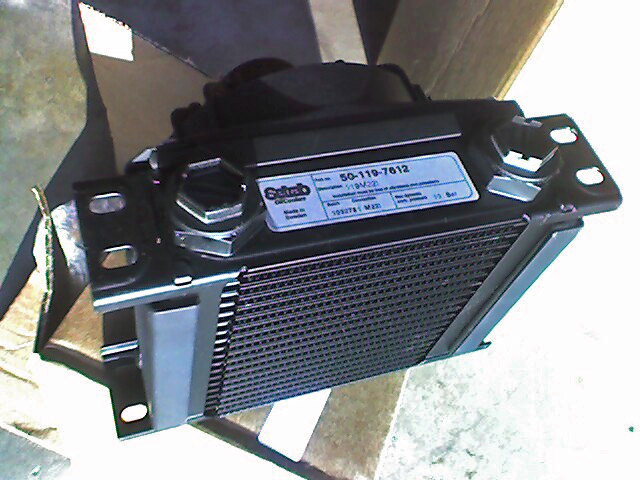
This is a 19 row radiator style cooler with a Spal fan. In my opinion, you cannot beat the quality and design of Setrab equipment. Being completely sealed and shrouded makes it hugely efficient and the Spal fan driving it is a nice piece as well.
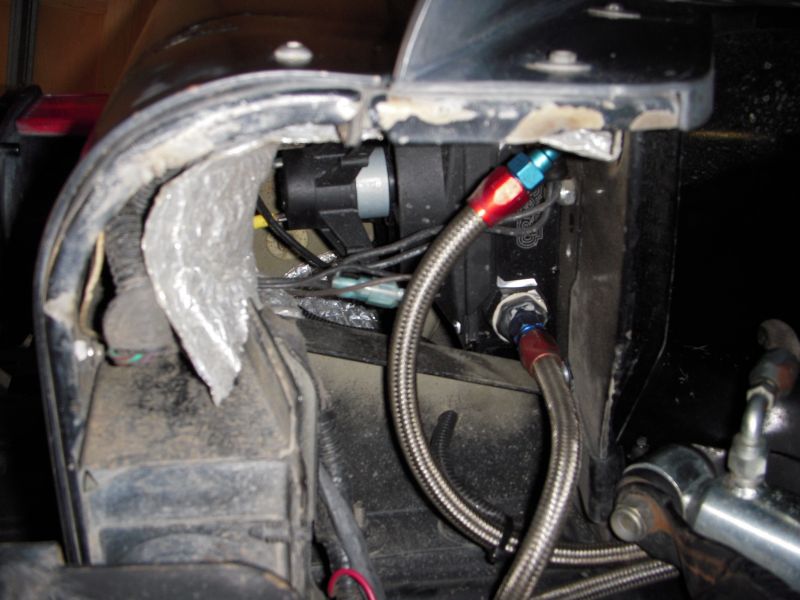
Here is the cooler mounted inside the corner. The photo was taken looking upwards into the tub. Since I long ago removed the plastic fender liners so that I could accommodate the outboarded shock mod, I needed only to cut out the remainder of the inner fender separating the wheel well from the corner so that the fanpack could be accommodated. This location (i.e. the cooler facing the wheel well) necessitated that a baffle be fabricated so that the cooler would not be damaged by debris kicked up by the tires or packed with mud and snow.
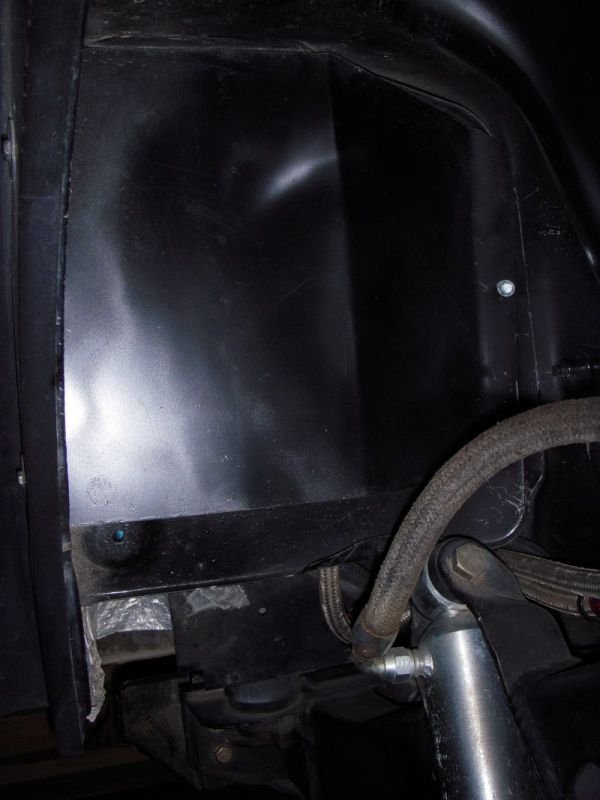
The fanpack operates by pulling air through so the baffle needed to be vented so as to provide good air flow to the cooler, as seen above. For all intensive purposes, it is inconspicuous.
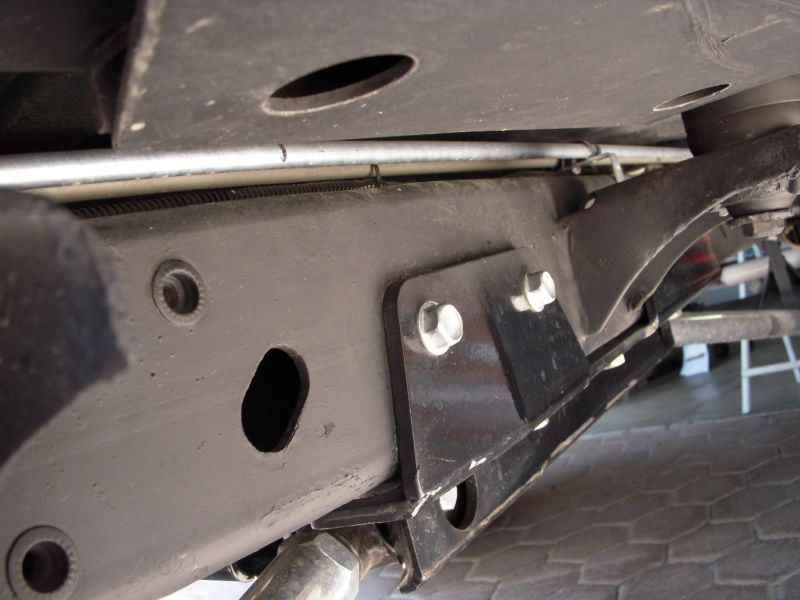
Plumbing is AN-6 or equivalent with solid line mounted along the top of the frame rail to minimize exposure to damage and flexible steel braided line used at each end.
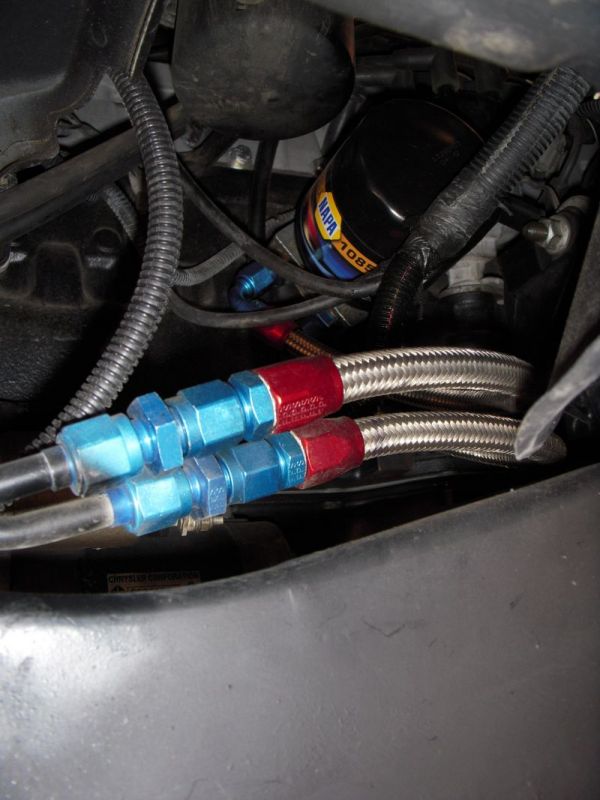
The adapter at the engine block for the oil filter is a Permacool (pn 181) which is a universal Chrysler model. This adapter also bypasses about 20% of the oil directly back to the engine without sending it to the cooler�.this is as much as a fail safe as anything. Non bypass adaptors are available but I wanted the failsafe even though it will cost me some efficiency in controlling engine oil temps.
Lastly, the fanpack is controlled via a thermostatic switch which is designed to come on at 180 and off at 170. It is also switched off a relay and located inside the cab next to the cigarette lighter so that I can manually over-ride it for cold days as well as water crossings.
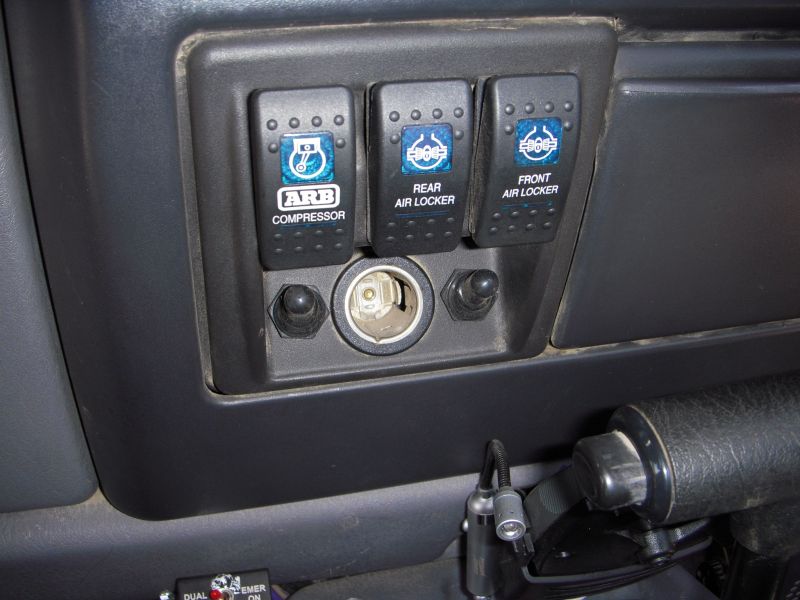
You can also see the manual over-ride switch for the transmission cooler.
Jeep Heat Dissipation Project
I have about 1000 miles on the Jeep now with the new cooler in place. Testing on the lines with the IR gun point to a 20* drop in temperature across in the input and output lines of the cooler with the fan engaged. There is not much difference to speak of with the fan in the off position. I feel that is a good thing for dealing with cold weather as oil that is too cold is as bad as oil that is too hot. What I see on road is a 4-12* drop in water temps with the fanpack fan running and while my rig will still run at 220*, it will not spike and stay at 230* for extended periods of time and we have experienced some triple digit temperatures here in So Cal so I feel that the project is a mild success.
I did not set out to drastically reduce operating water temps as every mod that I have put in place to do that has not achieved any significant reduction in water temps. What I wanted to do was build in reserve cooling capacity and I think with the fanpack, I now have that reserve. In fact, after the fanpack was installed and operating as it should, I had to go back and place foil insulation inside my rear corner as the heat reduction from the cooler caused some rather significant temperatures to occur on the rear corner. I didn’t consider that to be a bad problem to have as if it was heating up my corner then it wasn’t heating up my engine.
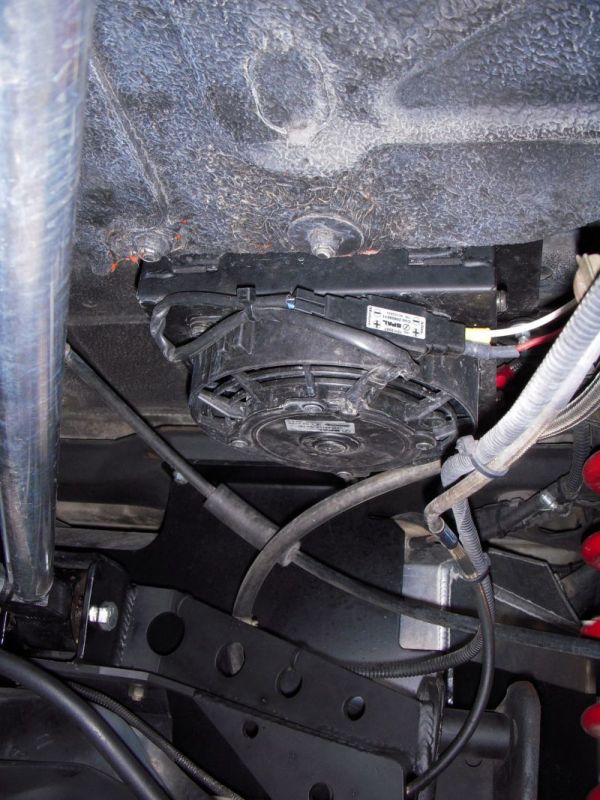
By now everyone has seen similar under tub installations of transmission coolers and this one really is no different and in fact, existed previously although with a different cooler. Being a fan of Setrab, I had tried to fit a much larger (32 row) fan driven cooler under the tub but with the rear trilink, I had to settle for a FP224M22.
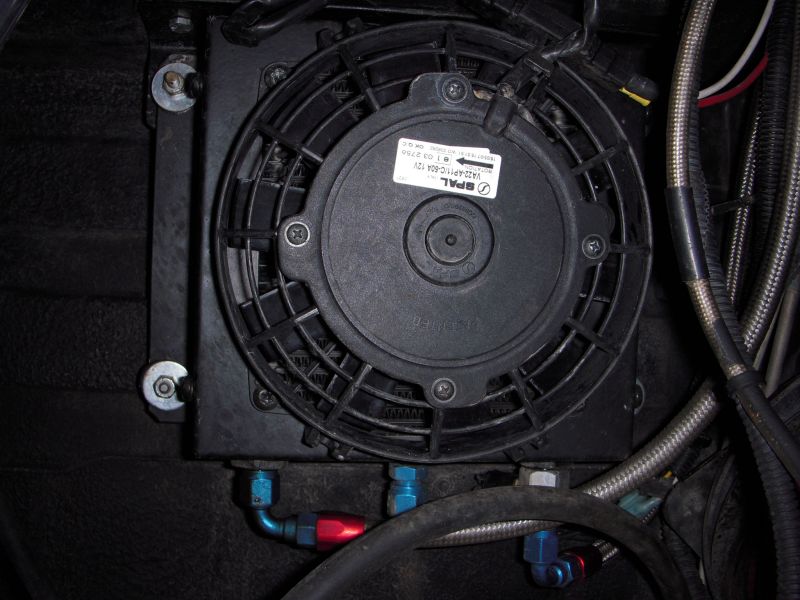
This a 24 row cooler and is similar in size to the B&M that I had previously used. I believe that the benefit of the Setrab is that it’s a radiator style cooler with a sealed shroud. I have not yet towed my trailer with it so I cannot report whether it is an improvement in that regard over the B&M or not. BTW, this cooler is not a standard stock item but is rather a specialty item for race applications. Setrab directed me to Weddle Industries in Goleta CA (805)562-8600 where I spoke directly with Chris Weddle and saw my cooler delivered to my doorstep from them 2 days later.
Lastly, I am a gear head at heart and while I do not currently own a hot rod or muscle car, I have always been a fan and have owned them in the past. Given that the ceramic coating business is a big deal in that realm of motorsports, I decided that it could not hurt my situation and would in fact help with heat build-up inside the cab. I have previously installed a Thermotec foil backed insulation under my carpet to insulate the inside of my cab but heat build-up was still a problem and my wife’s feet in the passenger seat would get downright hot. My exhaust is custom (i.e. it runs very close to the tub in places outside the stock heat shielding) as it needs to accommodate the long arm suspension I run as well as the high out-put of my built 4.0 motor. It is also handy that I have it flanged in 2 places beyond the header so that it can be easily removed in whole or part for maintenance.
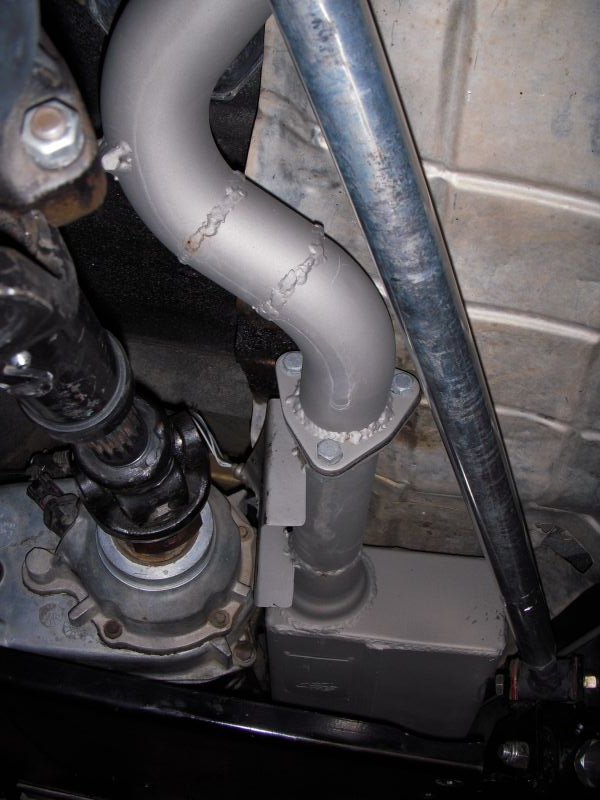
This photo gives you an idea on the coating which is a 2200* ceramic coating manufactured and applied by Embee Coatings in Santa Ana, CA. They have all kinds of coatings for exhaust, heads, piston tops and even very thin layer clears for appearances. For the $250 it cost me, I believe it has been a worthwhile modification as floor temps are judging from the wife-o-meter, much reduced and easier on her feet.
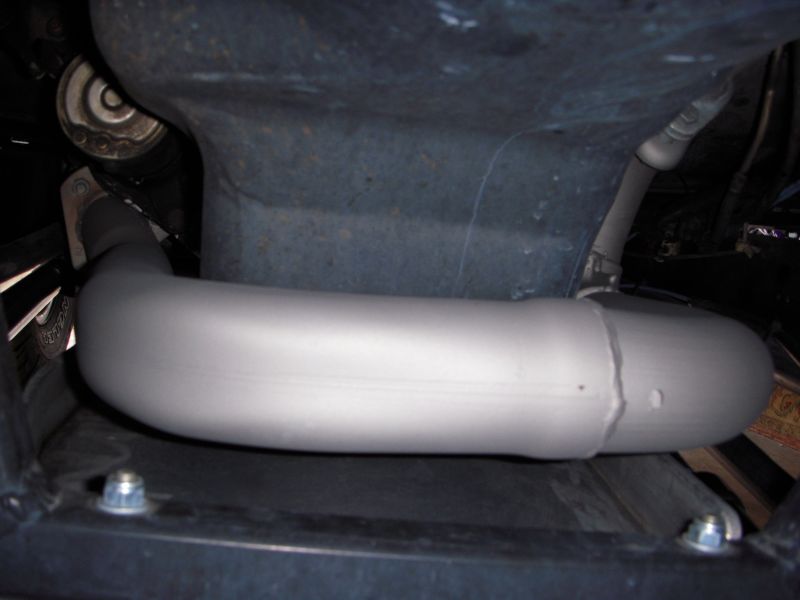
I would like to acknowledge John Lemiuex off All 4 Wheel Drive (951-277-1037)in Corona, CA for his advice, assistance and fabrication. If folks reading this are local to the So Cal area, please look him up for your vehicle and modification needs.
Note from Stu: I want to thank Robert for sharing this write-up with all of us. Nice looking work by the way! I look forward to hearing how all of this is working after some more good trips with the off-road trailer.